
 |
| Photo credit: Bang Painting |
On a freezing cold day in Michigan, Outer Lighthouse on St Joseph North Pier cuts a striking figure.
Thanks
to the harsh Midwest winter, it's morphed into an icicle sculpture -- a
grand, crystalized lookout illuminated by the light of a full moon.
It's just one of many eye-catching sights featured in "Lighthouses: Beacons of the Sea" -- a stunning image collection published by Amber Books.
The
new book showcases lighthouses across the world -- from the
traditional, nautical-striped Happisburgh Lighthouse in Norfolk, England, to the quirky, leaning Gadeokdo East Breakwater (West End) Lighthouse in Yeondo, Changwon, South Korea.
"The
appeal of lighthouses, I think it's quite a mixture of things. It's
partly because usually they are very striking structures in their own
right," author David Ross tells CNN Travel.
"And,
of course, they embody a particular kind of aspiration as well -- in
that they're among the few buildings perhaps that exist only for the
benefit of other people."
Altruistic architecture
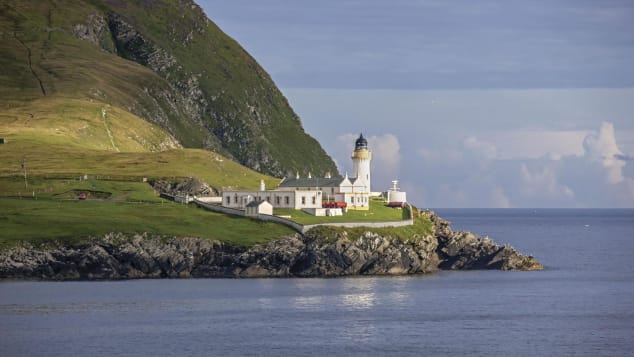
Bressay Lighthouse, Shetland, Scotland
Courtesy Shutterstock (Marc Andre Le Tourneux)
Ross is a historian who specializes in the stories behind historic buildings, ships and transport.
Growing up in the coastal far north of Scotland, the author remembers lighthouses capturing his imagination from an early age.
"I think I was 10 years old when I first climbed the hundreds of steps up to the top of a lighthouse," he recalls.
"And,
at night, from where we were, it was possible to see, I think, probably
the lights of three different lighthouses, each maybe 20 or 30 miles
away from each other, but each sending out a beam."
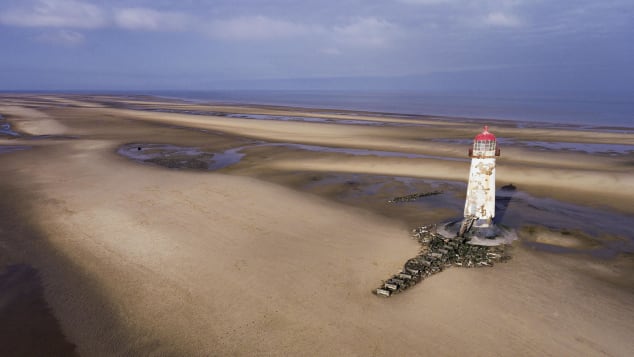
Point of Ayr Lighthouse, Talacre Beach, Flintshire, Wales
Courtesy Shutterstock (Brian Dicks)
Ross
was recruited to help tell the stories of 150 iconic lighthouses --
from rugged reminders of seafaring days of yore to modern reimaginings
that take lighthouses into the 21st century.
"We
wanted to [...] try as far as possible to show the development of a
lighthouses from certainly from around the 16th and 17th century, right
up to date," says Ross.
For
coastal communities across the globe, lighthouses are integral features
of everyday life. They're altruistic pieces of architecture, as Ross
puts it.

Gadeokdo East Breakwater (West End) Lighthouse, Yeondo, Changwon, South Korea
Courtesy Shutterstock (Igor Grochev)
It's this symbolic significance that means lighthouses still have a heady grip on our imaginations in the days of GPS.
"The image of the lighthouse as either a warning of danger or guiding you into a safe harbor, is a very strong one," says Ross.
"So
I think that that's why so many lighthouses that have been made
redundant by satellite navigation and so on have been taken over by
their local communities and still provided with a light in the tower --
because of that kind of significance that they have."
Lighthouse history

West Pierhead Lighthouse, Cleveland Harbor, Ohio, USA
Courtesy Dreamstime (Bryan Busovicki)
Lighthouse
history is long and varied, with early versions of the structures
popping up in ancient Egypt and in Roman times. It was in the Victorian
era that they became ubiquitous.
When working on the book, Ross turned to the University of North Carolina at Chapel Hill -- "the great center of lighthouse studies," as he calls it -- to illuminate his learning.
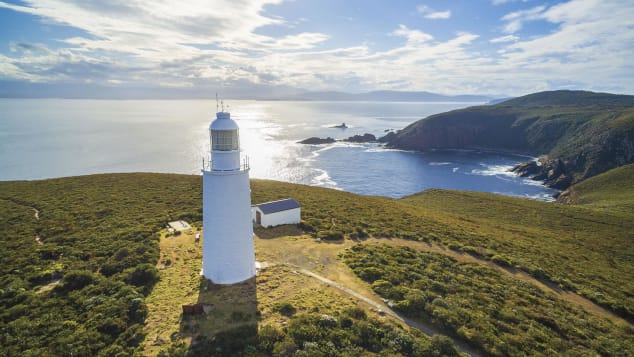
Cape Bruny Lighthouse, Tasmania, Australia
Courtesy Shutterstock (Greg Brave)
"There are many other sources as well, historic sources, you have to look at places like the British Library for example, the National Maritime Museum [in London] and a few other archives in order to try to make sure that one's got a good and reliable set of information," he adds.
Despite
being a lighthouse expert, Ross admits he hasn't visited every tower in
the book. The images were sourced from a variety of photographers and
global agencies.
"I've
probably been to, passed by -- or in some cases sailed past -- probably
most of the British ones or some of the Irish ones," says Ross.
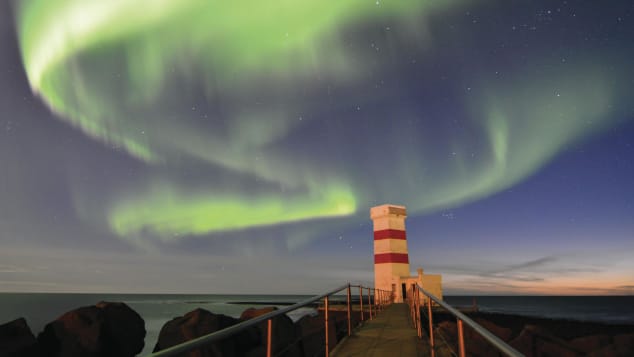
Gardskagi Old Lighthouse, Gardur, Iceland
Courtesy Shutterstock (Z-Lex)
But his favorite type of lighthouse is in Brittany, in northern France, across the water from his homeland.
"The
coast is very wild and rocky, mostly made up of granite, and the
lighthouses are built of exactly the same material, great strong granite
towers that just seemed to rise out of the rock," he says.
This
labor of love allowed Ross to add a few more lighthouses to his bucket
list. He's attracted to the uniqueness of some of the structures
featured -- particularly a pair of South Korean towers in the mold of
giant horses and a Thai lighthouse that's built to resemble a temple.
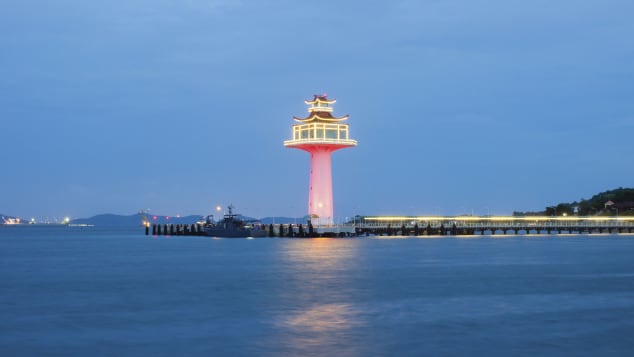
Ban Tha Thewawong Lighthouse, Koh Sichang, Chonburi Province, Thailand
Courtesy Shutterstock (Nathapon Triratanachat)
"In
the late 20th and 21st century there's been far more freedom for
designers using very modern materials to produce quirky and distinctive
designs that are a bit more than functional," says Ross.
"It's
probably got something to do with people's feelings about about
lighthouses that they can represent almost the spirit of the place."
Freedom and hope


No comments:
Post a Comment